Monday, October 18, 2021

Understanding Trigonometry in Taglish: Lesson 8 - Special Angles

 Note: Upang maunawaan ang araling ito, dapat ay napag-aralan muna ang Lesson 1 to 7.

LESSON 8 – SPECIAL ANGLES

Sa Lesson 1- 7, nakilala mo ang mundo ng Trigonometry. Nalaman mo ang tungkol sa mga linya at anggulo at kanilang mga sukat gayundin ang tungkol sa mga complementary at supplementary angles. Nalaman mo rin ang mga uri ng anggulo ayon sa sukat ng kanyang mga gilid at sukat ng angle na nabuo ng mga gilid, at kung ano ang anim na trigonometric functions.


Sa modyul na ito, malalaman mo ang tungkol sa mga values ng mga trigonometric functions ng mga espesyal na anggulo (special angles). Mapapahalagahan mo rin ang kahalagahan ng mga espesyal na anggulong ito habang inilalapat sa mga pang-araw-araw na sitwasyon sa buhay.

Naglalaman ang modyul na ito ng apat na aralin:

Lesson 8 — Special Angles/ Mga Espesyal na Anggulo

Lesson 9 — Reference Angles/ Mga Sangguniang Anggulo

Lesson 10 — Using a Scientific Calculator: Sin, Cos and Tan Keys/ Paggamit ng isang Scientific Calculator: Sin, Cos at Tan Keys

Lesson 11— Trigonometric Functions in Everyday Life/ Mga Trigonometric Function sa Pang-araw-araw na Buhay

PAG-ARALAN AT SURIIN NATIN

Ang Figure 1 sa ibaba ay nagpapakita ng isang equilateral triangle. Ang isang equilateral triangle ay isang tatsulok na may pantay o pare-parehong sukat  ng mga gilid (sides). Ang bawat anggulo sa isang equilateral triangle ay may sukat na 60o  ( 60 degrees). Matatandaan na ang kabuuang sukat ng mga angles sa isang triangle ay 180 degrees (180o).


Kapag hinati natin ang tatsulok sa Figure 1 sa dalawa sa pamamagitan ng pag-bisect ng isa sa mga anggulo, makakakuha tayo ng dalawang right triangles tulad ng ipinakita sa Figure 2.


Kung susuriin ang Fig. 2, dalawang triangles ang nabuo — triangles A at B. Pareho silang 30o – 60o right triangles. Sa isang tatsulok ng ganitong uri, ang hypotenuse ang pinakamahaba at  palaging dalawang beses ang haba sa pinakamaikling gilid/side;  ang mas mahaba namang gilid ay √3 times ang haba sa pinakamaikling gilid.

Ang pinakamaikling bahagi ay nasa tapat ng 30o angle, habang ang mas mahabang bahagi o gilid ay nasa tapat ng 60o angle. Ang hypotenuse ay laging katapat ng 90o angle o ng right angle.

Ipagpalagay na ang haba ng hypotenuse ng mga triangles A at B ay 2 units, samakatuwid, batay sa mga katangian ng isang 30o – 60o  right triangle, ang mga triangles A at B ay may mga sumusunod na sukat:


Dahil parehong right triangles ang dalawang tatsulok,gagamitin natin ang Pythagorean Theorem upang suriin kung tama ang mga sukat sa itaas.

Matapos lapatan ng Theorem ng Pythagorean, mayroon tayong:

c2 = a2 + b2
22 = 12 + (√3)2
4 = 1 + 3
4 = 4

Samakatuwid, ang mga sukat ay tama.

DAPAT UNAWAIN AT TANDAAN

Sa pagsagot ng mga problema na kinasasangkutan ng 30o-60o special triangle, dapat alalahanin ang mga sumusunod na katangian nito:

1. Ang hypotenuse ang siyang pinakamahaba ang sukat sa tatlong mga gilid o sides. Ito ay dalawang beses ang haba sa pinakamaliit na gilid.  Ito ay katapat ng 90o angle.

2. Ang gilid na mas maliit  sa hypotenuse  o mas mahaba sa pinakamaikling gilid  ay may sukat na √3 (square root of three) times ng sukat ng pinakamaikling gilid o side. Ito ay katapat ng 60o angle.

3. Ang pinakamaikling  gilid ay katapat ng 30o angle.

Upang lubos pang maunawaan ang konsepto sa itaas, sagutin natin ang problemang ito:

The hypotenuse of a 30° – 60° right triangle has a length of 9 units. What is the length of the other two sides?

Steps in Solving this problem

Step 1: Determine the given facts. 

length of hypotenuse = 9 units
Let’s call the hypotenuse as c; 
        c = 9 units

Step 2: Determine what is asked for in the problem.

The lengths of the other two sides

Step 3: Find the length of the shortest side.

We use the property of the 30°– 60° right triangle which states that the hypotenuse is always twice as long as the shortest side.

Let a = the shortest side
2a = c = the length of the hypotenuse 
Substituting the given length of the hypotenuse,
2a = 9
a = 9/2

Step 4: Find the length of the longer side.

We know that for a 30°– 60° right triangle that the longer side is √3 times as long as the shortest side. Designating b as the longer side, we have:

b  =  a (√3)   
      
Since a  =  9/2 (From Step 3),

b = 9/2 (√3) or 9/2 √3

Step 5. Use the Pythagorean theorem to check the values obtained.

a = 9/2      b = 9/2 √3  c = 9

Pythagorean Theorem:

        c2 = a2 + b2

92 = (9/2)2 + [9/2 √3]2
81 = 81/4 + 81/4 (3)
81 = 81/4 + 243/4
81 = 324/4
81 = 81

Our answer is correct.

MATUTO TAYO

Alalahanin natin ang 30o-60o right triangle sa Figure 2.


Makikita sa larawan na ang hypotenuse ay may habang 2 units. The side opposite the 30o angle has a length of 1 unit while the side adjacent to the 30oangle has a length of √3 (square root of 3).

Ang ating nakuhang mga sukat ay:

hypotenuse                          c = 2
side opposite 30° angle           a = 1 
side adjacent to 30° angle      b = √3

Using the definitions of the trigonometric functions, we have the following values for ∠30o based on c = 2; a = 1; and b = √3:

sin 30o   = opposite side/ hypotenuse =  a/c = 1/2
cos 30o   = adjacent side/ hypotenuse = b/c = √3/2
tan 30o  = opposite side/ adjacent side = a/b = 1/√3 or √3/3

Note:   The denominator √3 is a radical and the fraction was simplified by multiplying both the numerator and the denominator by the radical (1/√3  x  √3/√3 = √3/√9 = √3/3)

csc 30o  = hypotenuse/ opposite side = c/a = 2/1 = 2
sec 30o = hypotenuse/ adjacent side = c/b = 2/√3 or 2√3/3
cot 30o = adjacent side / opposite side = b/a = √3/1 = √3

Gamit ang  30o-60o  right triangle sa Figure 2, kunin natin ang mga values ng six trigonometric functions para sa ∠60o.


Batay sa larawan, ang mga sukat para sa ∠60o ay:

hypotenuse                 c = 2
side opposite 60o            a = √3
side adjacent to 60o  b = 1

Using the definitions of the trigonometric functions, we have the following values for ∠60o  based on  
hypotenuse c = 2 opposite side a = √3   adjacent side b = 1:

sin 60o = opposite side/ hypotenuse =  a/c = √3/2
cos 60o  = adjacent side/ hypotenuse = b/c = 1/2
tan 60o= opposite side/ adjacent side = a/b =  √3/1 or √3

csc 60o= hypotenuse/ opposite side = c/a = 2/√3 or 2√3/3

Note:   The denominator √3 is a radical and the fraction was simplified by multiplying both the numerator and the denominator by the radical ( 2/√3  x  √3/√3 = 2√3/√9 = 2√3/3

sec 60o= hypotenuse/ adjacent side = c/b = 2/1 or  2
cot 60o= adjacent side / opposite side = b/a = 1/√3 or √3/3

PAG-ARALAN AT SURIIN NATIN

Ang isa pang uri ng tatsulok na espesyal  o special triangle ay ang 45o – 45o right triangle. Ang tatsulok na ito ay isang isosceles triangle  at sa gayon ay may dalawang gilid/side na may parehong haba. Kung hahayaan natin na ang mga gilid na magkapareho ay may sukat na 1 at kung ang c ay kumakatawan sa hypotenuse, ang tatsulok ay kinakatawan ng Figure 3 sa ibaba.

                                                            Figure 3

Gamit ang  Pythagorean theorem, makakalkula natin ang value ng  hypotenuse  c:

        c= ?    a = 1        b = 1

        c2 = a2 + b2

Let's substitute the values:
        c2 = 12 + 12
c2 = 2
c = √2  (square root of 2)

Narito ang sukat ng mga gilid ng 45o-45o right triangle:

hypotenuse  c = √2  opposite side a = 1    adjacent side b = 1

 Kung gayon, ang  45°– 45° right triangle ay mayroong mga values para sa six trigonometric functions:

sin 45o  = opposite/hypotenuse = a/c = 1/√2 or  √2/2

cos 45o = adjacent/hypotenuse = b/c = 1/√2 or √2/2

tan 45o = opposite/adjacent = a/b = 1/1 or 1

csc 45o = hypotenuse /opposite = c/a = √2/1 or √2

sec 45o = hypotenuse/adjacent = c/b = √2/1 or √2

cot 45o = adjacent/opposite = b/a = 1/1 or 1

SUMMARY

1. Ang unang special angle na ating napag-aralan ay ang 30o-60o right angle kung saan nakabuo tayo ng 30o-60o right angle . Ito ay nakuha natin nang i-bisect natin ang isang angle ng isang equilateral triangle (triangle na may pare-parehong haba o sukat ang mga gilid o sides). 

2. Isa pang special triangle ay ang  45o-45o right triangle. Ang tatsulok na ito ay isang isosceles triangle (triangle na may 2 gilid na magkapareho ang haba o sukat) 

3. Base sa mga triangles na ito, napag-alaman natin ang values ng 6 na trigonometric functions para sa∠30o, ∠45o, at ∠60o. Tunghayan  ang mga values ng mga ito sa isang table sa susunod na pahina.


PAGSASANAY

1. The length of the hypotenuse of a 30o-60o right triangle is 7 units. Find the length of the other two sides. 

2. The length of the shortest side of a 30o-60o right triangle is 5 units. What is the length of the other two sides?

MGA SAGOT SA PAGSASANAY

The length of the hypotenuse of a 30o-60o right triangle is 7 units. Find the length of the other two sides. 

Step 1: Determine the given facts.

length of hypotenuse   c = 7 units

Step 2: Determine what is asked for in the problem.

length of the other two sides 

Step 3: Find the length of the shortest side.

In a 30o-45o60o right triangle, the shortest side is one-half the length of the hypotenuse or the hypotenuse is twice the length of the shortest side.

Let a = shortest side
a = 1/2c
a = ½ (7) = 7/2    or 3.5 units

Step 4: Find the length of the longer side.

In a 30o-60o right triangle, the longer side is √3   times
as long as the shortest side. 

Let b = shorter side
b = a (√3)
b = 7/2 (√3)  or     7/2 √3  units

Step 5: Use the Pythagorean theorem to check the values obtained.

        c2 = a2 + b2
          
72 =  (7/2)2 + (7/2 √3)2
49 = 49/4    +  [49/4  (3)]
        49 = 49/4   +  147/4
49 = 196/4
49 = 49

2. The length of the shortest side of a 30o-60o right triangle is 5 units. What is the length of the other two sides?

Step 1: Determine the given facts.

length of shortest side   a = 5 units

Step 2: Determine what is asked for in the problem.

length of the other two sides 

Step 3: Find the length of the longest side.

In a 30o-60o right triangle, the shortest side is one-half the length of the hypotenuse or the hypotenuse is twice the length of the shortest side.

Let c = longest side
c = 2a
c = 2 (5) = 10 units

Step 4: Find the length of the longer side.

In a 30o-60o right triangle, the longer side is √3   times
as long as the shortest side. 

Let b = shorter side
b = a (√3)
b = 5(√3)  or     5√3 units

Step 5: Use the Pythagorean theorem to check the values obtained.

c2 = a2 + b2

102 =  52 + (5√3)2
        100 = 25  +  [25(3)]
        100 = 25  +  75
        100 = 100

NOTE: If you want to view the lesson on YouTube, please click the link below and subscribe:


Wednesday, October 13, 2021

Understanding Trigonometry in Taglish: Lesson 7 - The Six Trigonometric Functions

 LESSON 7 – The Six Trigonometric Functions

Pagtutuunan natin sa araling ito ang tungkol sa anim (6) na Trigonometric Functions. Bago natin tukuyin ang mga katangian ng mga ito, balik-aralan muna natin ang mga bahagi ng right triangle kung saan nakabase ang anim na functions ng Trigonometry.


Sinasabing right triangle ang isang trianggulo o tatsulok kung ito ay may isang right angle. Ang right angle ay may sukat na 90 degrees (90o) o π/2 radian o 1.5708 radians ( 90 x π/180; where π≈ 3.1416).


Pagmasdan ang right triangle sa itaas:

Mayroong  espesyal na pangalan para sa bawat gilid o side ng isang right triangle. Ang dalawang gilid ng ΔXYZ (triangle XYZ)  na bumubuo ng right angle, XZ at YZ, ay tinatawag na mga binti  o legs ng tatsulok. Ang pangatlong gilid, XY, ay tinawag na hypotenuse. Ang hypotenuse ay ang gilid sa tapat ng right angle. Ito ang pinakamahabang gilid/side ng right triangle.

Sukatin natin ang haba ng mga gilid ng right triangle:

XY = 25 units YZ = 7 units XZ = 24 units

Ang tatsulok sa itaas ay may 2 acute angles. Alalahanin na acute angle ang tawag sa anggulo o salikop na may sukat na mas malaki sa zero degree ngunit mas mababa sa 90 degrees.

Ang mga acute angles na ito ay ang∠X (angle X) at ∠Y (angle Y).  Ang bawat isa sa mga ito ay naporma sa pamamagitan ng hypotenuse at isang leg o gilid. Ang ∠X ay produkto ng side XY at side XZ, samantalang ang ∠Y ay gawa ng side XY at side YZ.

Ang leg na kasama ng hypotenuse upang makagawa ng acute angle ay tinatawag na adjacent side/leg.

Sa ating halimbawang drawing sa itaas,  ang  leg/side adjacent sa ∠X ay side XZ (o XZ lamang). Ang leg naman adjacent sa ∠Y ay YZ. Dalawa ang side adjacent sa ∠Z; ito ay XZ at YZ.

Opposite side naman ang tawag sa gilid/side/leg na katapat ng angle na pinagbabatayan. Narito ang opposite side ng ating tatlong angle:
∠X ==> YZ ∠Y ==> XZ ∠Z ==>XY

Dapat tandaan na ang opposite side ng right angle (90 degrees) o ∠Z ay ang hypotenuse. Depende sa anggulo o salikop na pinagbabatayan, ang opposite side ng isang acute angle ay maaaring adjacent side naman ng isa pang acute angle at kabaliktaran o vice versa.

Halimbawa, ang opposite side ng ∠X ay YZ, samantalang ang YZ ay siyang adjacent side ng ∠Y; ang XZ ay ang opposite side ng ∠Y, samantalang  ang XZ ay siyang adjacent side ng ∠X .

PAGSASANAY A

Batay sa drawing sa ibaba, sagutin ang mga tanong:


hypotenuse = 
side adjacent to ∠A =
side opposite ∠A =
side adjacent to ∠B =
side opposite ∠B =
side opposite ∠C =
side/s adjacent to ∠C =

2. Batay sa drawing sa ibaba, sagutin ang haba ng mga gilid/side:


hypotenuse = 
side/s adjacent to ∠A =
side opposite ∠A =
side adjacent to ∠B =
side opposite ∠B =
side opposite ∠C =
side adjacent to ∠C =

(Tunghayan ang mga sagot sa ibaba)

Matapos nating malaman ang mga parte o bahagi ng isang right triangle, handa na tayong kilalanin ang anim na trigonometric functions. Ang mga ito ay ginagamit upang hanapin ang nawawalang mga parte ng mga right triangles.

The Six Trigonometric Functions

1. Sine of an Angle

The sine of A is the ratio of the length of the side opposite A to the length of the hypotenuse. The sine of A is abbreviated as sin A.

Ang sine ng A (angle A) ay ang ratio ng haba ng gilid sa tapat ng A sa haba ng hypotenuse. Ang sine ng A ay dinaglat bilang sin A. Samakatuwid,


Pagmasdan ang pigura sa ibaba:


Ayon sa drawing sa itaas, makikita na:

sin Q = opposite/hypotenuse = RS/QS = 9/15 

sin S = opposite/hypotenuse = QR/QS = 12/15

Pagmasdan ang pigura sa ibaba:


Ayon sa drawing sa itaas, makikita na:

sin D = opposite/hypotenuse = EF/DF = 24/26 

sin F = opposite/hypotenuse = DE/DF = 10/26

2. Cosine of an Angle

The cosine of A (angle A) is the ratio of the length of the side adjacent to A and the length of the hypotenuse. The cosine of A is abbreviated as cos A. 

Ang cosine ng A (angle A) ay ang ratio ng haba ng gilid katabi ng A sa haba ng hypotenuse. Ang cosine ng A ay dinaglat bilang cos A. Samakatuwid,


Pagmasdan ang pigura sa ibaba:


Ayon sa drawing sa itaas, makikita na:

cos Q = adjacent/hypotenuse = QR/QS = 12/15 

cos S = adjacent/hypotenuse =  SR/QS = 9/15

Pagmasdan ang pigura sa ibaba:


Ayon sa drawing sa itaas, makikita na:

cos D = adjacent/hypotenuse = DE/DF = 10/26 

cos F = adjacent/hypotenuse = EF/DF = 24/26

3. Tangent of an Angle

The tangent of A (angle A) is the ratio of the length of the side opposite A and the length of the side adjacent to A.  The tangent of A is abbreviated as tan A. 

Ang tangent ng A (angle A) ay ang ratio ng haba ng gilid katapat ng A sa haba ng gilid kalapit ng A. Ang tangent ng A ay dinaglat bilang tan A. Samakatuwid,

                    tan A = length of side opposite  A
        length of side adjacent to A


Pagmasdan ang pigura sa ibaba:

Ayon sa drawing sa itaas, makikita na:

tan Q = opposite/adjacent = SR/QR = 9/12 

tan S = opposite/adjacent =  QR/SR = 12/9

Pagmasdan ang pigura sa ibaba:


Ayon sa drawing sa itaas, makikita na:

tan D = opposite/adjacent = EF/DE = 24/10 

tan F = opposite/adjacent = DE/EF = 10/24

4. Cotangent of an Angle

The cotangent of A (angle A) is the reciprocal of the tangent of A. It is the ratio of the length of the side adjacent to A and the length of the side opposite A.  The cotangent of A is abbreviated as cot A. 

Ang cotangent ng A (angle A) ay ang kabaliktaran ng tangent ng A. Ito ay ang ratio ng haba ng gilid kalapit ng A sa haba ng gilid katapat ng A. Ang cotangent ng A ay dinaglat bilang cot A. Samakatuwid,

                    cot A = length of side adjacent to A
        length of side opposite A


Pagmasdan ang pigura sa ibaba:


Ayon sa drawing sa itaas, makikita na:

cot Q = adjacent/opposite = QR/SR = 12/9 

cot S = adjacent/opposite =  SR/QR = 9/12

Pagmasdan ang pigura sa ibaba:


Ayon sa drawing sa itaas, makikita na:

cot D = adjacent/opposite = DE/EF = 10/24 

cot F = adjacent/opposite = EF/DE = 24/10

5. Secant of an Angle

The secant of A (angle A) is the reciprocal of the cosine of A. It is the ratio of the length of the hypotenuse and the length of the side adjacent to  A.  The secant of A is abbreviated as sec A. 

Ang secant ng A (angle A) ay ang kabaliktaran ng cosine ng A. Ito ay ang ratio ng haba ng hypotenuse sa haba ng gilid kalapit ng A. Ang secant ng A ay dinaglat bilang sec A. Samakatuwid,

                    sec A = hypotenuse                  
        length of side adjacent to A


Pagmasdan ang pigura sa ibaba:


Ayon sa drawing sa itaas, makikita na:

sec Q = hypotenuse/adjacent = QS/QR = 15/12 

sec S = hypotenuse/adjacent =  QS/SR = 15/9

Pagmasdan ang pigura sa ibaba:


Ayon sa drawing sa itaas, makikita na:

sec D = hypotenuse/adjacent = DF/DE = 26/10 

sec F = hypotenuse/adjacent = DF/EF = 26/24

6. Cosecant of an Angle

The cosecant of A (angle A) is the reciprocal of the sine of A. It is the ratio of the length of the hypotenuse and the length of the side opposite  A.  The cosecant of A is abbreviated as csc A. 

Ang cosecant ng A (angle A) ay ang kabaliktaran ng sine ng A. Ito ay ang ratio ng haba ng hypotenuse sa haba ng gilid katapat ng A. Ang cosecant ng A ay dinaglat bilang csc A. Samakatuwid,

                csc A =  hypotenuse                  
      length of side opposite A


Pagmasdan ang pigura sa ibaba:


Ayon sa drawing sa itaas, makikita na:

csc Q = hypotenuse/opposite = QS/SR = 15/9 

csc S = hypotenuse/opposite =  QS/QR = 15/12

Pagmasdan ang pigura sa ibaba:


Ayon sa drawing sa itaas, makikita na:

csc D = hypotenuse/opposite = DF/EF = 26/24 

csc F = hypotenuse/opposite = DF/DE = 26/10


PAGSASANAY B

1. Pagmasdan ang drawing sa ibaba at sagutin ang mga tanong:


sin A =                sin C =
cos C =               cos A =
tan A =                tan C =

2.Pagmasdan ang drawing sa ibaba at sagutin ang mga tanong:


sin Y =                 sec Z =         
cos Y =                cot Z =
tan Y =                csc Z

3. If sin B = 8/3, then csc B = ______.

A. 8/3 B. 3/8 C. 3/3 D. 8/8

4. If tan W = 12/13, then 13/12 is ______.

A. csc W         B. sec W         C. cos W         D. cot W

5. Right Δ123 has sides 3, 4, and 5 units. The hypotenuse of the triangle is ______ units.

A. 3         B. 4         C. 5  D. 12

6. Right ΔJKL has sides 9, 12, and 15 cm. If ∠K is the right angle and side JK = 12 cm, then cot L = _____?

A. 9/12 B. 12/15         C. 9/15 D. 12/9

Tandaan

• The two sides of the triangle that form the right angle are called its legs. The third side is called its hypotenuse.

• The leg that helps form an acute angle in a right triangle is said to be adjacent to that angle.

• The same leg is said to be opposite the other acute angle.

• The hypotenuse is always the side opposite the right angle and it is the longest side.

Upang matandaan ang formula para sa sine, cosine, at tangent, alalahanin ito:
SohCahToa, kung saan ang S = sine, o = opposite, h = hypotenuse, C = cosine, at T = tangent. Kaya, 
Soh ==>sine A = o/h or opposite/hypotenuse
Cah==>cosine A = a/h or adjacent/hypotenuse
Toa==>tan A = o/a or opposite/adjacent


Tandaan din na:

Ang cotangent  ay kabaliktaran ng tangent . Kung ang tan A = opposite/adjacent,  ang cot A = adjacent/opposite.

Ang secant ay kabaliktaran ng cosine. Kung ang cos A = adjacent/hypotenuse, ang sec A = hypotenuse/adjacent.

Ang cosecant ay kabaliktaran ng sine. Kung ang sin A = opposite/hypotenuse, ang csc A = hypotenuse/opposite.

SAGOT SA PAGSASANAY


Saturday, October 9, 2021

Understanding Trigonometry in Taglish: Lesson 6 - Converting Degrees to Radians and Vice Versa

 LESSON 6 – Converting DEGREE to RADIAN and vice versa

Matapos nating mapag-aralan ang mga uri ng linya, salikop o anggulo, trianggulo, complementary at supplementary angles, gayundin ang katuturan ng Pythagorean Theorem, sa leksyon 6 ay susubukin naman nating lubos na maunawaan ang degree at radian.


Sa araling ito, malalaman mo ang pagkakaiba sa pagitan ng dalawang yunit ng pagsukat na ginamit para sa mga anggulo: degree at radian. Malalaman mo rin kung paano i-convert ang isang unit sa isa pa.
Ang araling ito ay mahalaga sapagkat may mga problema na maaaring matugunan mo sa hinaharap na nagsasangkot ng pagsukat ng mga anggulo.

Pagmasdan ang bilog sa ibaba:


CIRCUMFERENCE = the yellow ring


The circumference is the distance around a circle. It is always equal to 360 unit (either  degree (o) or radian (rad)).

A degree is a unit of measurement equal to 1/360 of the circumference of a circle. 

From this, we can conclude that:

     90o = 90 (1/360) of the circumference = ¼ of the circumference 
   180o = 180 (1/360) of the circumference = ½ of the circumference 
   270o = 270 (1/360) of the circumference = ¾ of the circumference


The circumference of a circle = 2π (2 pi). (pi is pronounced as “pie”)
π (pi) = is a symbol that has a constant value. Ito ay katumbas ng 3.1416 o ≈ 3.1416 na nakuha matapos i-divide ang circumference sa 2 radius (o diameter).

 Hindi eksakto ang value ng pi kaya ginagamit ang simbolong ≈, na ang ibig sabihin ay “approximate”. 

There are π/180o or 0.01745 rad in 1°. So, to convert degrees to radians, we multiply the number of degrees by π/180o or 0.01745 rad. 
 
Ang isang degree ay may katumbas na π/180o o  0.01745 rad. Kung gayon, para ma-convert ang value ng degree sa radian, i-multiply lamang ang degree sa π/180o  o  0.01745 rad..

Mga Halimbawa
Convert the following degrees into radians.

1. 30o  = 30o (π/180o) = 3π/18 = π/6 rad
2. 90o  = 90o (π/180o) = 9π/18 = π/2 rad
3. 225o  = 225o (π/180o) = 45π/36 = 5π/4 rad
4.  74o = 74o (0.01745) = 1.2913 rad
5. 300o = 300o (0.01745) = 5.235 rad

There are 180o/π or 57.2956o  in 1 rad. Thus, to convert radians to degrees, we multiply the number of radians by 180o/π or 57.2956°.
 
Ang isang radian o 1 rad ay may katumbas na 180o/π  o  57.2956 degrees. Kung gayon, para ma-convert ang value ng radian sa degree, i-multiply lamang ang radian sa 180o/π  o  57.2956o.

Mga Halimbawa
Convert the following radians into degrees.

1. 3π/4 rad = 3π/4 (180o/π) = 540/4 = 135o
2. 5π/3 rad = 5π/3 (180o/π) = 900/3 = 300o
3. 11π/6 rad = 11π/6 (180o/π) = 1980/6 = 330o
4. 0.6 rad = 0.6 (57.2956o) = 34.3774o
5. 2π rad =  2 (3.1416) (57.2956o) = 360o

Tandaan

1. A degree is equal to 1/360 of the circumference of a circle.

2. A radian, if placed at the center of a circle, makes an arc equal to the radius of the circle.

3. p180° rad or .01745 rad = 1°

4. To convert degrees to radians, we multiply the number of degrees by π/180° or  0.01745.

5. 180°/p or 57.2956° = 1 rad.

 6. To convert radians to degrees, we multiply the number of radians by 180°/π or 57.2956°.


A pi (π) has an approximate value of 3.1416  or 22/7.  π =  circumference/diameter of a circle


Monday, October 4, 2021

Understanding Trigonometry in Taglish: Lesson 5 - Triangles

Lesson 5 - Triangles


Bago natin suungin ang aralin tungkol sa triangle o trianggulo na siyang pinakabasehan ng Trigonometry, alalahanin nating muli ang ating mga napag-aralan na:


• An angle is formed by two rays with a common endpoint. The two rays are called the sides of the angle and the common endpoint is called the vertex.

• Angles are usually named using three capital letters of the English alphabet. But they can also be named using numbers or letters of the Greek alphabet.

• A protractor is an instrument used to measure an angle. The units of measurement for angles are degrees (°) or radians (r).

• Angles are classified according to their measurements.

• Acute angle — an angle whose measurement is less than 90°.

• Right angle — an angle whose measurement is exactly 90°.

• Obtuse angle — an angle whose measurement is more than 90°

but less than 180°.

• Straight angle — an angle whose measurement is exactly 180°.

• Reflex angle — an angle whose measurement is more than 180°

but less than 360°.

• If the sum of the measurements of two angles is 90°, they are complementary angles.

• To find the measurement of the complement of a given angle, subtract the measurement of the given angle from 90°.

• If the sum of the measurements of two angles is 180°, they are supplementary angles.

• To find the measurement of the supplement of a given angle, subtract the measurement of the given angle from 180°.

After learning all about angles in the previous lesson, you are now ready to tackle more complicated figures such as triangles. This lesson will focus on the different kinds of triangles. The knowledge you will gain from this lesson will hopefully help you in solving real-life problems. 

Matapos mong malaman ang lahat tungkol sa mga anggulo sa nakaraang aralin, handa ka na ngayon upang harapin ang mas kumplikadong mga pigura tulad ng mga triangles. Ang aralin na ito ay magtutuon sa iba't ibang mga uri ng mga triangles. Ang kaalamang makukuha mo mula sa araling ito ay sana makatulong sa iyo sa paglutas ng mga problema sa totoong buhay.

Ano ang triangle?

A triangle is a polygon with three sides and three angles.

Ang trianggulo ay isang polygon na may tatlong gilid at tatlong anggulo.


Masdan ang triangle sa itaas. Ang simbolo para sa isang trianggulo ay D. Tatawagin nating  D QRP ang pigura sa itaas. Ang sides o mga gilid ng D QRP ay QR (RQ), QP (PQ), at RP (PR). Ang tatlong angles naman ay ÐQ,  ÐR, at ÐP.

What are the different kinds of triangles?

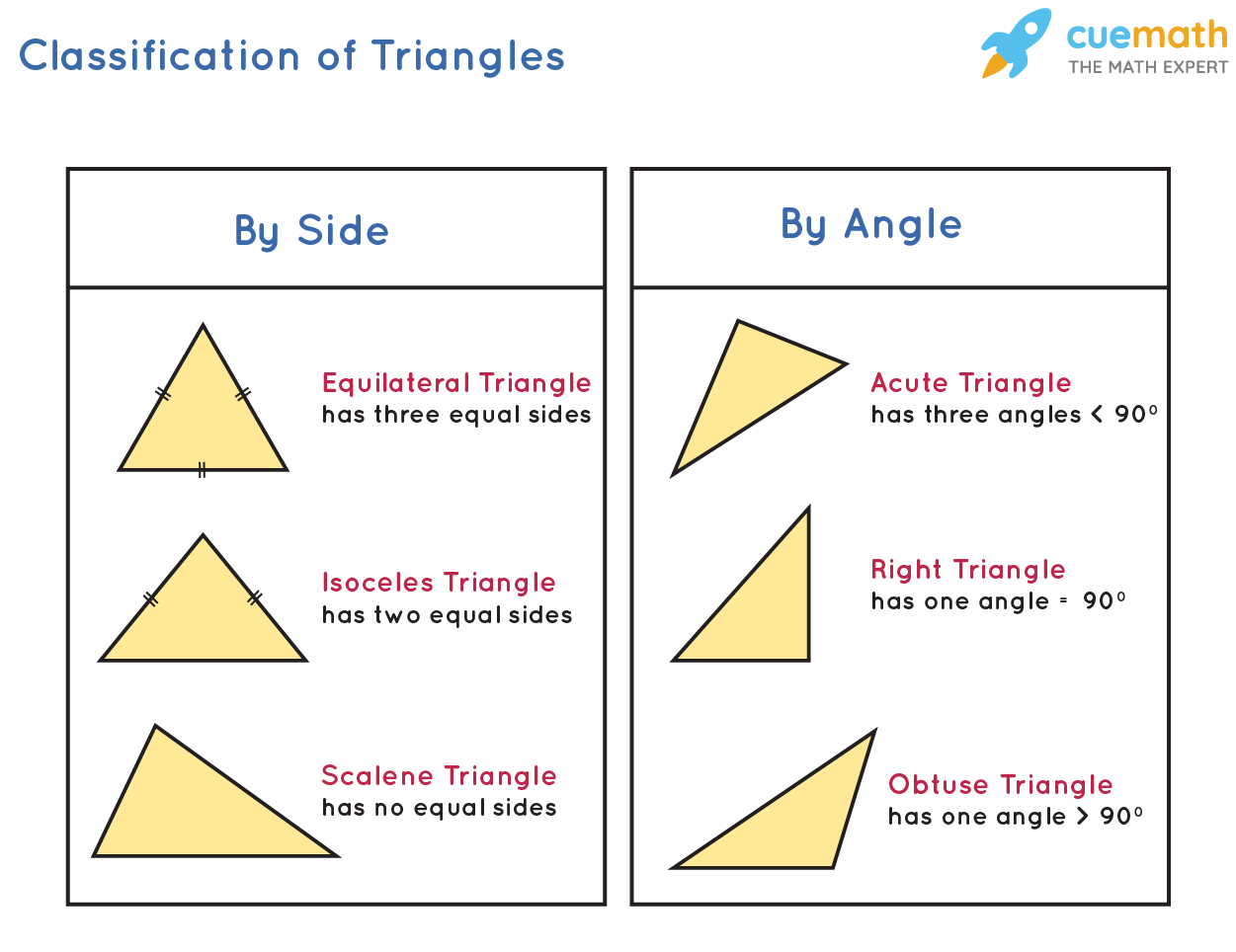
A. Triangles are classified according to the lengths of their sides.
Ang mga trianggulo ay kinaklase ayon sa haba ng mga sides/gilid nito.

1. A scalene triangle is a triangle with no congruent side. Congruent means having the same or equal measure.


In the above figure, PQ ≠ QR ≠ PR, so ΔPQR is a scalene triangle.

2. An isosceles triangle is a triangle with two congruent sides.

3. An equilateral triangle is a triangle with three congruent sides.


B. Triangles are also classified according to the kinds of angles that make them up.

1. A triangle with a right angle is called a right triangle. A right angle measures 90 degrees.


2. A triangle that is made up of three acute angles is called an acute triangle. An acute angle measures more than zero degrees but less than 90 degrees.


3. A triangle with an obtuse angle is called an obtuse triangle. An obtuse angle measures more than 90 degrees but less than 180 degrees.


In summary, triangles are classified according to the lengths of their sides and the angles that they make up. See the illustration below from  https://www.cuemath.com to understand and remember the concept:


Pagsasanay

        Upang matasa kung nauunawaan ang leksyon, sagutin ang mga sumusunod na katanungan:

1. Magkakasukat ang tatlong gilid o sides ng isang trianggulo. Ang triangle na ito ay tinatawag na __________ triangle.

A. right 
B. equilateral
C. isosceles
D. acute

2. Isa sa mga angles ng triangle na ito ay may sukat na 91 degrees. Ang triangle na ito ay isang ________ triangle.

A. right
B. acute
C. obtuse
D. isosceles

3. Ang isosceles triangle ay may magkakaparehong sukat ng _______ gilid o sides.

A. isa
B. dalawa
C. tatlo
D. apat

4. May tatlong acute angles ang triangle na ito na hindi magkakapareho ang sukat. ________ triangle ang tawag dito.

A. acute
B. scalene
C. obtuse
D. right

5. Ang mga sides o gilid ng triangle na ito ay iba-iba ang mga sukat. Ang tawag sa triangle na ito ay ________ triangle.

A. equilateral
B. isosceles
C. reflex
D. scalene

6. Ang sukat ng  mga angles ng isang equilateral triangle ay _________.

A. iba-iba
B. 30 degrees
C. 45 degrees
D. 60 degrees

7. Ang supplementary angle ng ÐY = 30 degrees ay _______ degrees.

A. 60
B. 90
C. 150
D. 330

8. Alin sa mga sumusunod na pares ang complementary angles?

A. Ð2  = 30o    |     ÐA = 30o
B. Ð3  = 35o    |     ÐB = 35o
C. Ð4   = 45o   |     ÐC = 45o
D. Ð5   =  90o  |     ÐM = 90o

9. Ang triangle na ito ay may dalawang gilid na magkakapareho ang sukat. _______ triangle ang tawag dito.

A. isosceles
B. equilateral
C. complementary
D. right

10. Ilang right angle mayroon ang isang right triangle?

A. wala
B. isa
C. dalawa
D. tatlo

Mga sagot sa pagsasanay